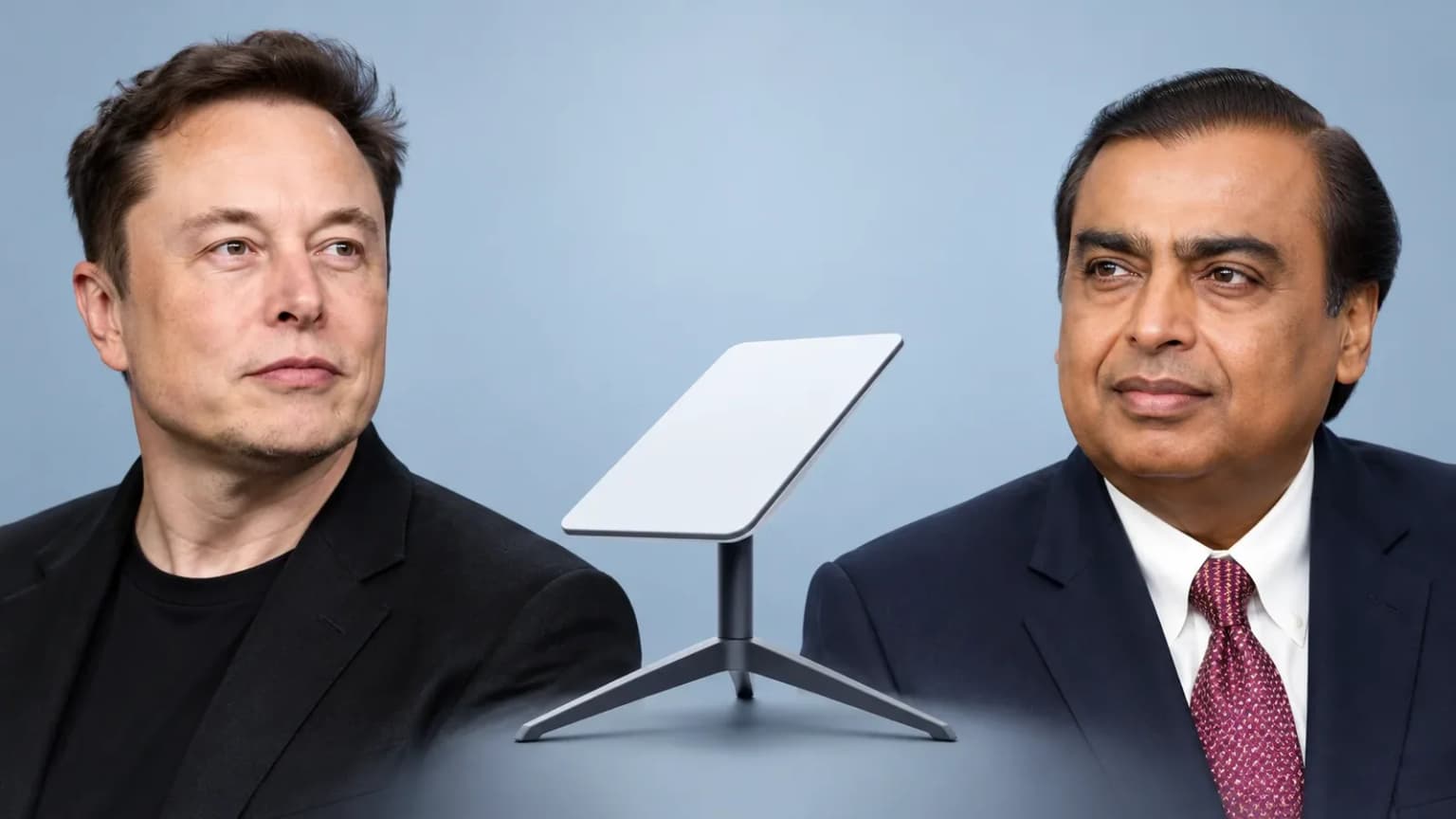
Elon Musk vs Mukesh Ambani over Starlink centers on a simple question: why has SpaceX’s satellite internet service still not launched commercially in India despite receiving important approvals? Musk has accused powerful business interests of obstructing competition and singled out Ambani. India’s government rejects the accusation and says security assessments remain underway.
As of October 10, 2026, the evidence supports a more complicated explanation than a billionaire blocking his rival. Starlink already holds an Indian telecom license, and Ambani’s Jio previously agreed to distribute its service. Neither fact eliminates the remaining regulatory hurdles.
What triggered the latest confrontation?
On October 7, Musk alleged on X that unnamed oligarchs were blocking Starlink to preserve their market power. On October 8, he explicitly questioned Ambani’s influence over the approval process. He escalated the criticism again on October 9 with a sarcastic message addressing the Reliance chairman as India’s prime minister. Business Insider
Those comments put Elon Musk vs Mukesh Ambani over Starlink back in the headlines. But Musk’s allegation is not an established finding that Ambani controls government decisions.
For readers following the story, that distinction matters. A public accusation establishes what Musk believes or wants to communicate; it does not establish who caused a regulatory delay.
Why India matters to both companies
Starlink’s commercial opportunity is to connect places where conventional broadband is unavailable or difficult to install. India’s communications ministry identifies remote, mountainous, coastal, and underserved areas as potential beneficiaries of satellite connectivity.
Ambani’s Reliance group operates Jio, a major Indian telecom business with mobile and fixed broadband operations. A new satellite provider creates another option for customers and another participant in the competition for connectivity revenue. rilstaticasset.akamaized.net
Seen commercially, Elon Musk vs Mukesh Ambani over Starlink concerns market access and influence over the rules governing that access. However, satellite broadband can complement existing networks as well as compete with them. A connection for an isolated business is a different proposition from replacing an affordable urban fiber subscription.
Why a license does not equal a launch
The most useful fact in Elon Musk vs Mukesh Ambani over Starlink is also the easiest to overlook: Starlink has already received a significant Indian license.
In a January 29, 2026 parliamentary response, India’s government listed Starlink Satellite Communications among three companies granted a Unified License with authorization for Global Mobile Personal Communication by Satellite services, commonly abbreviated GMPCS.
On October 8, the communications ministry said security assessments were underway for all three relevant licensees. It explained that completing that process would allow a licensed operator to seek spectrum assignment.
These are separate milestones:
| Milestone | What it tells readers |
|---|---|
| Telecom license | The company has received authorization under a specified licensing framework. |
| Security assessment | Authorities are evaluating compliance with the license’s security conditions. |
| Spectrum assignment | The operator obtains access to radio frequencies needed for service. |
| Commercial availability | Customers can actually order and activate an authorized service. |
The table explains the milestones rather than providing a complete legal checklist. Other applicable permissions and operational conditions can also matter.
Consequently, describing the Starlink India launch delay as simply “no license” obscures the real question: which remaining conditions have been satisfied, and which approvals are still pending?
The government’s response deserves scrutiny, too
India’s ministry says its framework treats applicants fairly and that the three operators are at broadly the same regulatory stage. That is the government’s stated position, rather than independent proof that every aspect of the process is flawless.
For Elon Musk vs Mukesh Ambani over Starlink, a useful test is whether authorities publish clear requirements and whether applicants can demonstrate compliance against them. Transparent decisions would help readers distinguish ordinary security review from inconsistent treatment.
The available official statement identifies an unfinished assessment. It does not establish a commercial launch date or substantiate Musk’s allegation against Ambani.
Jio and Starlink also signed a partnership
Elon Musk vs Mukesh Ambani over Starlink is particularly unusual because their companies have already announced plans to work together.
On March 12, 2025, Jio Platforms announced an agreement with SpaceX to offer Starlink services in India, subject to SpaceX receiving the necessary authorizations. Jio said it would distribute equipment through retail outlets and online stores and support installation and activation.
The announcement also described Starlink as complementary to JioFiber and JioAirFiber.
For Elon Musk vs Mukesh Ambani over Starlink, that partnership complicates a simple rivalry narrative. Companies can disagree over regulation while cooperating on distribution. An incumbent may benefit from selling a new service even when that service overlaps with its own offerings.
The agreement does not prove that today’s disagreement is resolved. It does show why rivalry alone is an incomplete explanation.
What spectrum has to do with the dispute
Spectrum means the radio frequencies that communications systems use to carry signals. Satellite operators need rules governing access, interference, and payment before they can provide service.
India’s telecom regulator published recommendations on spectrum assignment for certain satellite commercial services on May 9, 2025. The existence of recommendations should not be confused with confirmation that a particular operator has received its frequencies.
This distinction helps explain Elon Musk vs Mukesh Ambani over Starlink without treating every regulatory announcement as a launch announcement. Policy development, individual authorization, and customer availability answer different questions.
What customers should evaluate beyond the feud
Elon Musk vs Mukesh Ambani over Starlink may attract attention, but eventual customers need answers about price, performance, and support.
Consider a hypothetical remote lodge with unreliable internet. Its owner should compare the total equipment, installation, electricity, and subscription costs against the value of dependable bookings and payment processing. A city household with reliable fiber would make a different comparison.
Speed alone is insufficient. Latency, the time it takes data to travel to its destination and back, affects video calls and other interactive applications. Starlink’s engineering documentation explains that routing, ground infrastructure, and network load influence that delay.
Customers should look for location-specific availability and published Indian terms rather than assume that overseas prices or performance will apply. Satellite coverage on a map is not itself permission to activate service.
How to recognize a meaningful update
The next significant development in Elon Musk vs Mukesh Ambani over Starlink will be a documented change in launch readiness.
Look for an official security-clearance update, spectrum assignment, confirmed ordering availability, and published service terms. A partnership announcement or another social media exchange cannot substitute for those details.
For American and British readers, the broader lesson is about international technology expansion: a working product and a willing distributor do not automatically settle a country’s regulatory requirements.
Until the remaining milestones are confirmed, treat Elon Musk vs Mukesh Ambani over Starlink as a dispute over market access with unresolved allegations. Check government notices and Starlink’s official ordering information before interpreting the next headline as proof that service has arrived.