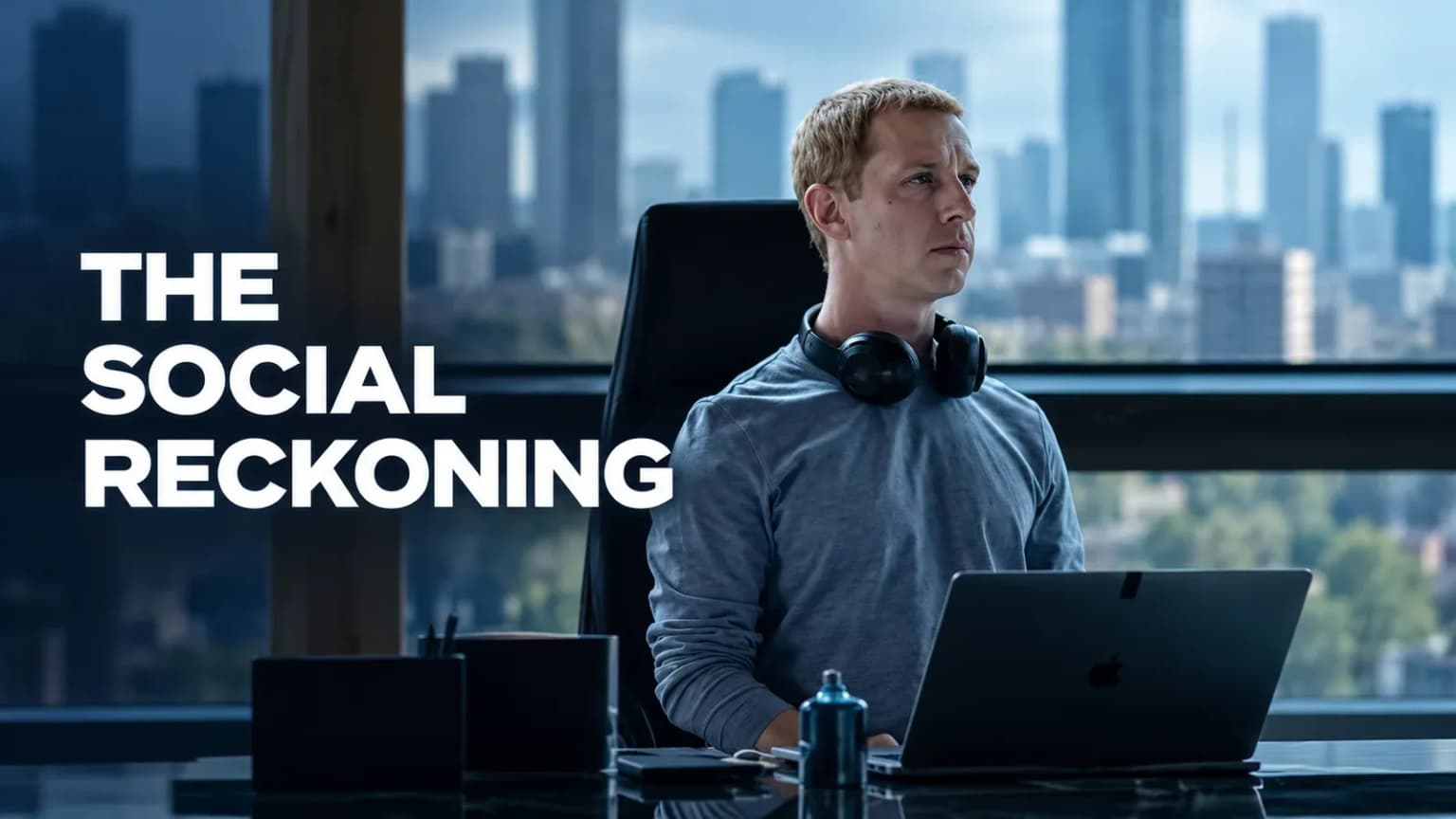
Sixteen years after The Social Network turned Facebook's founding into an Oscar-winning drama, Aaron Sorkin is back with a follow-up that puts the company's 2021 whistleblower scandal on screen. The Social Reckoning opens nationwide Friday, October 9, 2026, with Thursday previews, and the first wave of reviews is already in. The short version: critics agree it is competently made and well acted, and they mostly agree it will not change how anyone feels about Facebook.
This article pulls together what the film covers, what reviewers across the spectrum are saying, who is in the cast of The Social Reckoning, and whether the movie is worth your ticket this weekend. It draws on published reviews and production reporting, not a private screening, and it says so where that matters.
The verdict in one paragraph
The Social Reckoning is a solid legal thriller with a strong central performance from Jeremy Strong and a sharp one from Mikey Madison, held back by a script that explains more than it dramatizes and an ending reviewers describe as softer than the story deserves. If you follow tech news, you already know every revelation in it. If you don't, the film is a clear, watchable primer on what the Facebook Files showed. Either way, it is a postmortem, not an exposé.
What the film is about
Sorkin wrote and directed The Social Reckoning himself; David Fincher, who directed the 2010 film, did not return. The story runs on two tracks. On one, Facebook data scientist Frances Haugen (Mikey Madison) discovers internal research showing the platform's engagement-driven algorithm amplifies rage, misinformation, and extremist content, and leaks thousands of documents to Wall Street Journal reporter Jeff Horwitz (Jeremy Allen White). On the other, Mark Zuckerberg (Jeremy Strong) prepares for congressional testimony with his legal team, sparring with a former ally played by Bill Burr about free speech and responsibility. The two tracks converge around January 6, 2021. (Source: Wikipedia, production and plot summary)
The real Facebook Files were published by the Journal in September 2021, based on documents Haugen provided, and covered the platform's effects on teen mental health, its handling of misinformation, and its separate rules for high-profile users. Haugen testified before the Senate the following month.
What the critics are saying
As of October 7, The Social Reckoning holds a 70 percent score on Rotten Tomatoes from 42 reviews, with an average rating of 6.4 out of 10, and a 52 on Metacritic. The Social Network sits at 96 percent from 335 reviews. (Source: Dark Horizons review roundup; Forbes)
That split is real, not a statistical accident. The reviews break into three camps.
It works as a warning. Liz Shannon Miller at Consequence gave it a B+ and called it "a blistering movie pointing out the corrosive effects of Facebook on society," arguing the platform's continued reach among older adults makes the film essential even if its facts are familiar. Victoria Luxford at NME said the third act "makes the movie's argument about the dangers of social media hard to ignore," while noting the film "feels more like a postmortem than an exposé." (Source: NME)
It is fine, and that is the problem. Several critics landed on "perfectly okay," in Metro's phrase. The common complaint is the missing Fincher: Alonso Duralde at The Film Verdict wrote that "the greatest flaw of The Social Reckoning is that David Fincher isn't directing." Jeff Cronenweth returned as cinematographer, but reviewers found the look flatter than the 2010 film.
It fails on its own terms. William Bibbiani at TheWrap called it "a generic journalistic potboiler" and argued the ending undercuts the title: Zuckerberg walks away with few consequences, and "that's not what a reckoning is." (Source: TheWrap) Nick Schager at The Daily Beast said the script "exaggerates to the point of reduction" by turning Zuckerberg into a one-note villain. (Source: Forbes)
Notice what is absent from all three camps: nobody argues the film will move a viewer from one side of the Facebook debate to the other. Supporters say it is a necessary reminder; detractors say it preaches. Both descriptions assume the audience already has a position.
The cast of The Social Reckoning
|
Actor |
Role |
What critics say |
|---|---|---|
|
Jeremy Strong |
Mark Zuckerberg |
The most praised element. NME says he "plays Zuckerberg like a king"; TheWrap calls the impression "blunt and numbing." Divisive by design. |
|
Mikey Madison |
Frances Haugen |
Consequence calls her the standout and one of Sorkin's best-written women; TheWrap finds the character thin. |
|
Jeremy Allen White |
Jeff Horwitz, Wall Street Journal |
Dry, sarcastic, well delivered; most reviewers call the role underwritten. |
|
Bill Burr |
Charlie, former Zuckerberg ally on the legal team |
Widely praised in the hearing-prep scenes. |
|
Wunmi Mosaku |
Raya, Zuckerberg's counsel |
Singled out by NME as excellent. |
|
Betty Gilpin, Billy Magnussen |
Supporting roles |
Not discussed in most reviews. |
Jesse Eisenberg, who was Oscar-nominated for playing Zuckerberg in 2010, declined to return. Strong, who won an Emmy for Succession, built the part apart from his co-stars: Jeremy Allen White said he did not hear Strong's Zuckerberg voice until the trailer, because the two actors' storylines barely overlap and they did not spend time together on set. (Source: Wikipedia, citing cast interviews)
Behind the camera: Alexandre Desplat composed the score, replacing Trent Reznor and Atticus Ross, who won the Oscar for the first film. Filming ran from October 22 to December 9, 2025, in Vancouver under the working title Goliath. The film is rated R.
The Social Reckoning trailer vs. the finished film
The Social Reckoning trailer, first shown at CinemaCon on April 14 and released online June 10, sold the movie as a tense, witty two-hander: Haugen telling Horwitz "I am here to help Facebook, not hurt it," and Strong's Zuckerberg introducing himself at a deposition as a "professional defendant." (Source: Motion Picture Association)
Reviews suggest The Social Reckoning trailer is accurate about the tone and the best lines, and slightly misleading about the balance. The Zuckerberg scenes that dominate the trailer are a smaller share of the film than the Haugen-Horwitz procedural, which is where critics say the pacing drags. If you bought a ticket for two hours of Strong, you are getting less than that.
Who should see it
See it if you liked Spotlight or The Post, you want a clear explanation of how engagement algorithms actually work (several critics praised Sorkin's plain-language version), or you want to judge Strong's Zuckerberg for yourself.
Skip it, or wait for streaming, if you followed the Facebook Files closely in 2021, you expect the visual precision of the first film, or the phrase "Sorkin monologue" makes you tired.
Worth knowing before you go: The Social Reckoning is rated R, it is a legal and newsroom drama with no action, and the January 6 sequence is the emotional center of the third act. The ending is more hopeful than the preceding two hours; several critics saw that as the film pulling its punch.
For why a well-reviewed drama can still struggle commercially against the 2010 film's roughly $224 million worldwide gross, see our explainer on how box office numbers work.
The takeaway
The Social Reckoning is a good film about a story most of its audience already knows, made by a writer who is better at explaining a scandal than at making you feel it. It will satisfy people who think Facebook got off easy and irritate people who think Hollywood has it out for tech. It will not create many converts in either direction, which is the one thing a movie called a reckoning most needed to do.