Your closet may already contain enough clothes for fall, yet getting dressed still feels difficult. The problem might be that your favorite jeans, sweaters, and jackets have never been organized into outfits that work together.
A fall capsule wardrobe is a smaller selection of clothes you can combine for your everyday life. To build one without shopping, start with pieces that fit comfortably, test complete outfits, and keep enough options for your weather and laundry schedule. You do not need a new color palette, matching hangers, or a prescribed number of garments.
Start with the week you actually live
Before pulling clothes off hangers, look at your next seven days. How often will you dress for work, walk outdoors, run errands, or meet friends? Which activities require different shoes or layers?
A useful fall capsule wardrobe should reflect those answers. If you work from home most days, a fall capsule wardrobe built around office blazers may leave you reaching outside it constantly.
Write down your three most common situations and what each requires. For example:
- Office days: comfortable trousers, presentable tops, and a layer for a chilly workspace.
- Errands and school runs: washable clothes and shoes you can walk in.
- Casual evenings: familiar basics with a favorite shirt, sweater, or accessory.
Check the forecast, too. Build for the temperatures you expect this week, then rotate warmer pieces in as conditions change.
Shop your closet before making a checklist
Gather the clothes you already wear regularly, including items waiting in the laundry. Start with these proven favorites instead of emptying every drawer.
Try on anything you have not worn recently. Sit down, reach forward, and walk around. A waistband that pinches or a sweater that itches will not become more useful because it fits a seasonal theme.
Sort your candidates into three groups:
- Ready now: comfortable, clean, and suitable for upcoming activities.
- Needs attention: missing a button, needing cleaning, or requiring a repair you can realistically arrange.
- Not for this rotation: unsuitable for the weather, uncomfortable, or unnecessary this month.
Keep the third group separate without making immediate donation decisions. Building a fall capsule wardrobe does not require getting rid of the rest of your clothes.
Next, identify the colors that already repeat among your favorites. Denim, navy, cream, olive, burgundy, or bright shades can all work. Choose combinations you enjoy wearing rather than trying to make everything beige.
Give each piece a practical job
Think of fall capsule wardrobe essentials as functions: something comfortable underneath, something warmer over it, suitable bottoms, and dependable footwear.
Your version might use sweatshirts instead of cardigans or sneakers instead of boots. There is no reason to purchase a trench coat simply because it appears on someone else's list.
As an optional starting exercise, choose:
- Five everyday tops.
- Three bottoms.
- Two sweaters, cardigans, or other middle layers.
- One outer jacket suited to current conditions.
- Two pairs of shoes that serve different needs.
That gives you 13 pieces to test, not a rule to follow. Keep underwear, socks, sleepwear, workout clothing, uniforms, and special-event outfits outside this exercise.
Increase the selection if your laundry schedule, work requirements, or need for clean changes demands it. A fall capsule wardrobe should make ordinary life easier, including the days when several favorites are in the wash.
Build outfits before declaring the capsule finished
Clothes can look coordinated on hangers and still feel awkward together. A sweater might bunch under your jacket; trousers might drag with your usual shoes.
Try complete outfits, including footwear. For each bottom, find two tops you like with it and at least one suitable layer. This tests the versatility of your fall capsule wardrobe, not a requirement that every garment match everything.
Photograph successful combinations on your phone. Note the weather or occasion beside each photo so you can find a useful outfit quickly.
A hypothetical 13-piece example
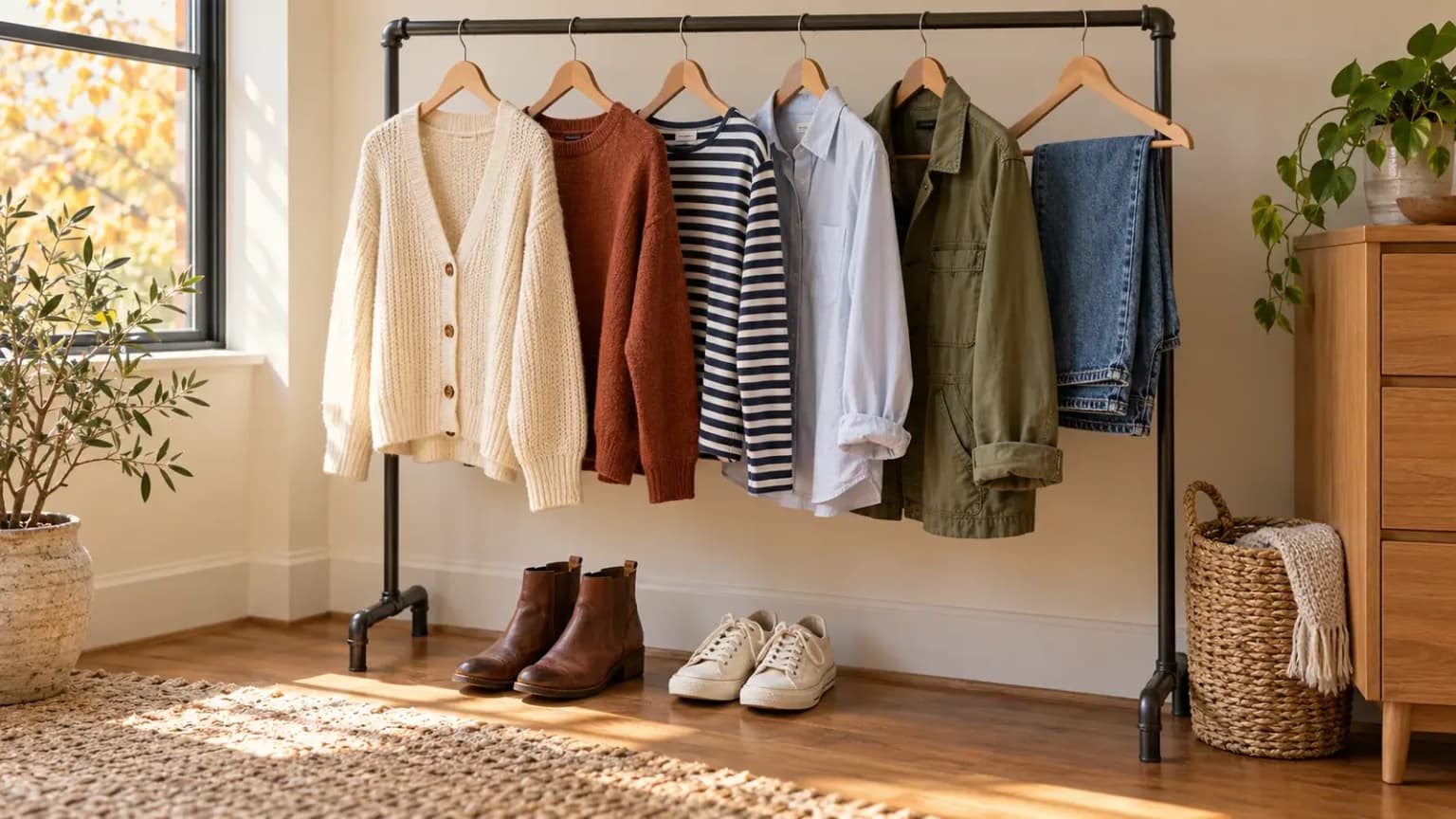
Imagine someone already owns two T-shirts, a striped long-sleeve top, a button-down shirt, a lightweight turtleneck, jeans, black trousers, olive pants, a cardigan, a sweater, a rain jacket, sneakers, and ankle boots.
Here are five possible outfits from that selection:
| Situation | Existing clothes to combine |
|---|---|
| Casual workday | Button-down shirt, black trousers, cardigan, ankle boots |
| Weekend errands | T-shirt, jeans, sweater, sneakers |
| Cool morning walk | Long-sleeve top, olive pants, rain jacket, sneakers |
| Casual dinner | Turtleneck, black trousers, ankle boots |
| Relaxed afternoon | T-shirt, olive pants, open button-down shirt, sneakers |
Add the rain jacket when conditions call for it, assuming it fits over the chosen layers. Substitute footwear suitable for the actual weather.
This example is a starting point, not a shopping list. Your fall capsule wardrobe might use skirts, dresses, different silhouettes, or entirely different colors.
Make summer pieces work harder
A summer-to-fall wardrobe transition can begin with familiar T-shirts and shirts. Keep pieces that remain comfortable beneath another layer.
Try an open button-down over a tee, a cardigan over a sleeveless top, or a sweater with your usual lightweight trousers on a mild day. A dress may still work with tights and a jacket if you already own those pieces and enjoy the combination.
When layering clothes for fall, test movement as well as warmth. Put the outer layer on, fasten it, and bend your arms. If the sleeves pull or the shoulders feel restricted, choose a thinner middle layer.
Adjust your fall capsule wardrobe to your surroundings. In a warm climate, removable lightweight layers may be enough. Colder conditions may require a warmer coat and different footwear. Do not force a summer garment into weather it cannot comfortably handle.
Refresh what is keeping good clothes out of rotation
Sometimes a useful piece needs attention rather than replacement. Sew on a loose button, clean shoes according to their care instructions, or set aside a repair you have the skills to complete.
Before washing or applying heat, check the garment's label. The Federal Trade Commission's care-label guidance explains that instructions address cleaning methods and warnings about procedures that could damage clothing. Federal Trade Commission
Build maintenance into your fall capsule wardrobe planning. If most of your selected clothes require care you rarely have time for, bring easier-care alternatives into the rotation.
Avoid experimenting with aggressive cleaning or heat to rescue a favorite item. If the label is missing or unclear, seek guidance appropriate to the garment before treating it.
Run a seven-day trial and record the friction
Give your fall capsule wardrobe one ordinary week before changing it. Place the chosen clothes together in an accessible section of your closet; no new organizers are necessary.
Each evening, record anything that made dressing difficult. Be specific: “Both comfortable tops were drying” is more useful than “I need more clothes.”
Then respond to the actual problem:
- Not enough clean tops? Bring another existing top into the rotation.
- Always too warm indoors? Swap a heavy sweater for a removable layer.
- Nothing feels right for work? Revisit existing workwear before adding casual pieces.
- An outfit depends on uncomfortable shoes? Rebuild it around footwear you already trust.
Do not treat outfit repetition as failure. A fall capsule wardrobe lets you reuse combinations that work while keeping enough variety to feel like yourself.
If a genuine need remains, name it precisely and explore an existing substitute, repair, or borrowed item. Necessary replacements can wait outside the no-shopping experiment rather than becoming a reason to rebuild everything.
Start tonight by choosing one familiar bottom, two tops, and a comfortable layer. Try both outfits, take a photo, and leave tomorrow's choice ready to wear.