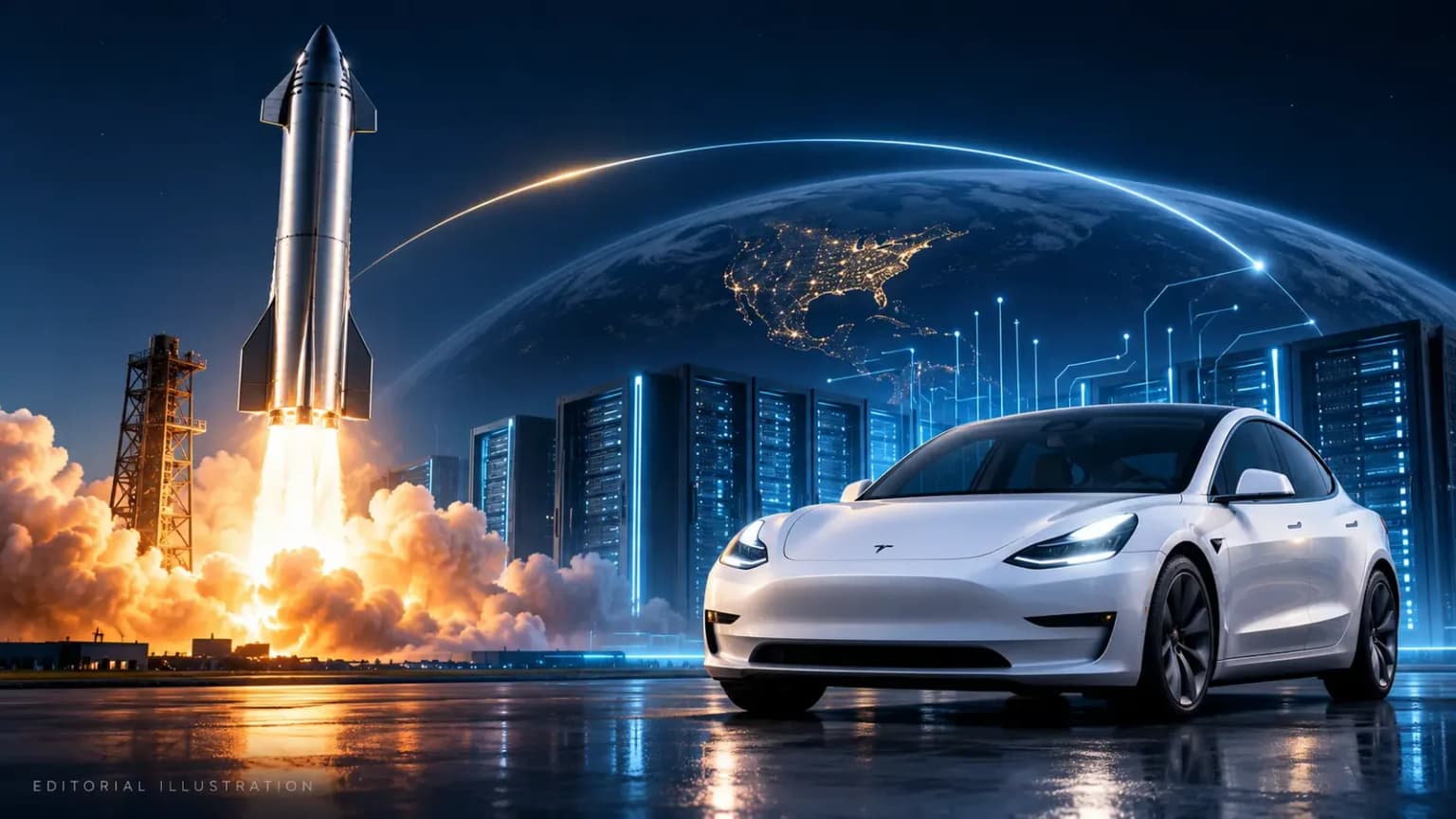
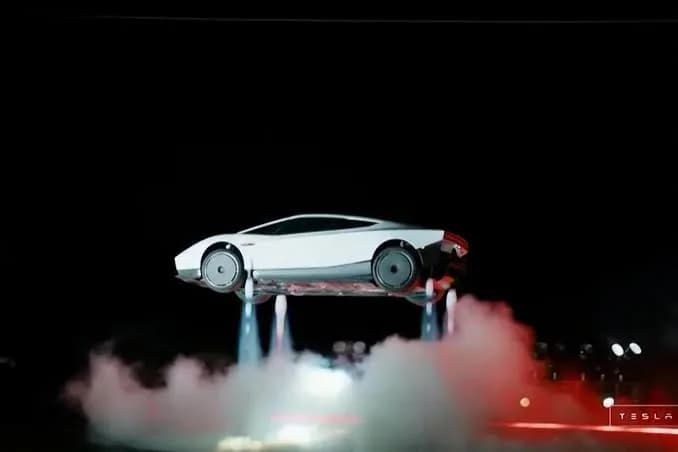
The new Tesla Roadster appears to do something impossible: leave a ramp upside down, rotate in the air, and land on its wheels. The explanation involves two different systems. Suction keeps the vehicle against the ramp, while thrusters help control its movement after it leaves the surface.
Tesla demonstrated the redesigned Tesla Roadster at SpaceX’s test site in McGregor, Texas, on October 15, 2026. Reuters reported that it drove inverted, turned in midair, and landed using onboard thrusters. The event also included a separate airborne maneuver over other vehicles.
That spectacle deserves a careful explanation. A planned aerial maneuver does not establish that a car can automatically rescue its occupants during an unexpected rollover.
What the Tesla Roadster demonstration actually showed
There are three stages to understand: maintaining contact with the curved ramp, rotating after departure, and reaching the ground in a controlled position.
The event coverage described a fan-based suction system beneath the vehicle and cold-gas thrusters used during its aerial maneuvers. Those systems perform different jobs; the mechanism that helps the car cling to a surface is not interchangeable with the one that changes its movement in open air.
The Tesla Roadster operated without a driver inside, according to reporting from the event. That matters when interpreting the footage: a successful unoccupied demonstration does not, by itself, establish passenger readiness.
How suction lets a car drive upside down
A fan car creates a low-pressure region underneath its body by drawing air away. The pressure difference produces a force that holds the vehicle toward the surface beneath its wheels. With sufficient force and suitable conditions, that attachment can overcome the vehicle’s weight when the surface is overhead.
There is an established example of this principle. In April 2025, McMurtry documented its Spéirling driving upside down on a purpose-built rotating platform. The company said its fan system held the vehicle against the inverted surface, after which the driver moved forward unsupported.
McMurtry’s own technical description explains that its fans draw air from a sealed region beneath the chassis. That is useful background for understanding fan-generated downforce, although it is not documentation of Tesla’s specific hardware.
The distinction helps explain the ramp video: staying attached to an overhead surface and supporting a vehicle in free air are separate engineering problems.
How Tesla Roadster SpaceX thrusters control rotation
Thrusters generate force by expelling material in a particular direction. NASA’s explanation of thrust describes the basic relationship: accelerating gas one way produces a force in the opposite direction. NASA’s thrust guide
A familiar illustration is an untied balloon. Air escapes through its opening, and the balloon moves in the opposite direction. A controlled thruster system makes the direction and timing of that force deliberate.
Rotation requires another ingredient: where the force acts.
A push directed through an object’s center of mass mainly changes its motion. A push whose line of action misses that center can also turn it. Engineers call that turning effect torque. Think of pushing a door near its handle instead of near its hinges.
A NASA-hosted study of spacecraft thruster arrangements describes how nozzle placement and direction determine the forces and turning effects available to a control system. That principle explains how strategically positioned jets can rotate a vehicle without its tires touching the ground. NASA technical paper
This is an explanation of the underlying physics, not a reconstruction of Tesla Roadster’s software. The reviewed material does not establish the exact firing sequence, sensor inputs, or control settings used in the stunt.
Why turning upright is only half the landing problem
A car can be correctly oriented and still be falling too quickly. Managing its rotation and managing its descent therefore require separate consideration.
NASA distinguishes thrust’s direction from its strength. Applying that principle, upward thrust can oppose gravity, while appropriately positioned thrust can change orientation. Enough upward force is needed to reduce an existing downward speed, rather than merely slow the rate at which that speed increases. NASA
Hypothetical example: Picture a model vehicle descending roof-first. Turning it wheels-down solves the orientation problem. It still needs a sufficiently gentle touchdown. A dramatic clip showing the first action does not quantify the forces involved in the second.
Is this really a Tesla Roadster flying car?
The phrase “Tesla Roadster flying car” describes the striking visual, but readers should ask what kind of airborne capability has actually been established.
A brief maneuver does not answer questions about flight duration, operating range, repeated attempts, or performance in changing weather. Those require their own measurements.
It also matters which version of the vehicle is being discussed. Tesla’s official Roadster page includes qualifications about features restricted to the Rocket trim and specifications associated with an optional Thrust upgrade. Its regional product information also makes availability subject to applicable requirements. Readers should not assume every Tesla Roadster configuration includes the same equipment. Tesla | Tesla regional qualifications
For anyone following the Elon Musk flying car headlines, these are the useful distinctions:
| Question | Evidence worth looking for |
|---|---|
| Can it perform an airborne maneuver? | A documented demonstration with its operating conditions explained |
| Can it fly for practical journeys? | Measured duration, range, payload, and repeatability |
| Can passengers use the demonstrated capability? | Testing and operating limits for the exact configuration |
| Will a customer’s car include it? | Final specifications and purchase terms for that version |
The table separates four questions that a single impressive video cannot settle.
When evaluating footage, look for an uninterrupted view of departure, rotation, and touchdown. Then check whether the accompanying explanation identifies remote operation, test equipment, and any external assistance. These details help establish what was demonstrated; a dramatic camera angle alone cannot provide a complete independent engineering assessment.
Why the stunt does not prove automatic rollover protection
Calling the Tesla Roadster a car that “straightens itself while falling” leaves out the conditions surrounding the maneuver.
An unexpected road accident might involve damage, an uncontrolled spin, an obstruction, or very little distance before impact. A planned demonstration does not establish how the system would behave in those circumstances.
To support a Tesla Roadster accident-recovery claim, the company would need evidence specifically addressing that function: when it activates, what conditions it can handle, and what happens when recovery is impossible. The sources reviewed for this article do not establish such a verified consumer feature.
This is the same evaluation problem that appears in other emerging technologies. Daily US Wire’s coverage of laundry-folding robots examines the distance between a demonstrated task and dependable everyday use. The tasks differ, but the question remains useful: under what conditions does the system work?
What comes next for the Tesla Roadster
Tesla has announced a 2028 production target for the redesigned Roadster. That is a company timeline, not confirmation that customer deliveries have begun.
The next meaningful updates should clarify the equipment included in each version, independently measured performance, passenger operating limits, and where the relevant capabilities can be used.
When another clip circulates, check the vehicle configuration and the stated test conditions before treating it as a feature announcement. Those details will tell readers far more about the car they might eventually encounter than the height of its next jump.