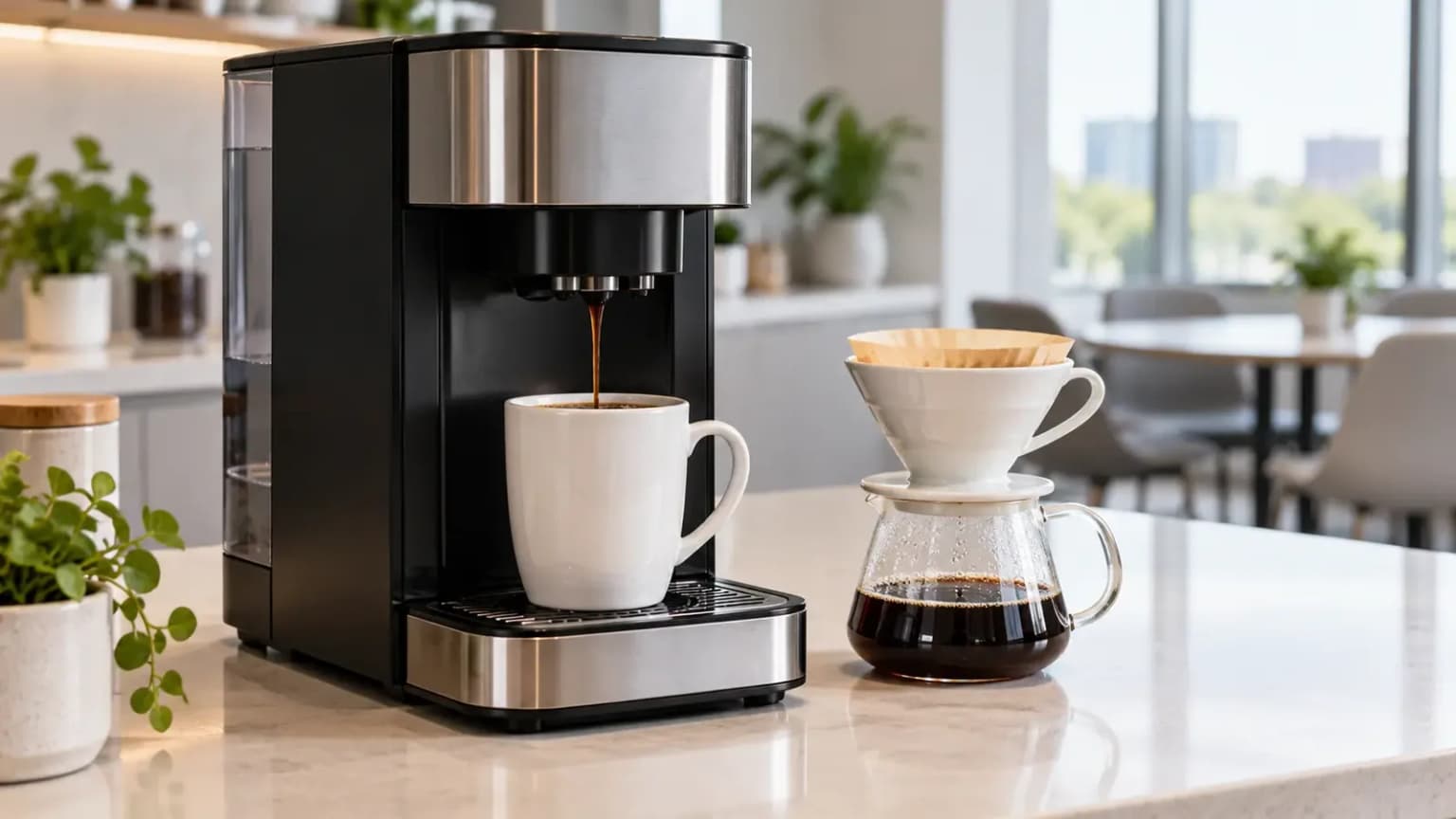
Your second or third cup from the break room may deserve a closer look, especially if you are watching your cholesterol. Research on office coffee machine health risks suggests that some workplace machines leave substantially more cholesterol-raising coffee compounds in the cup than paper-filtered brewing does.
The practical response is to check how your coffee is filtered. A Swedish study published in 2025 raised concerns about certain machines, but it did not establish that every office coffee maker is harmful or that drinking workplace coffee causes heart attacks.
What researchers actually found
Researchers working with Uppsala University and Chalmers University of Technology examined coffee from 14 workplace machines in Sweden: 11 brewing machines and three machines that prepared drinks from liquid coffee concentrate.
The study, published in Nutrition, Metabolism and Cardiovascular Diseases, measured cafestol and kahweol. These naturally occurring compounds belong to a group called diterpenes and can raise cholesterol.
Median cafestol concentrations were 176 milligrams per liter in the brewing-machine samples, compared with 12 milligrams per liter in home-brewed, paper-filtered coffee. Results varied widely, including within machine categories.
That distinction matters when discussing office coffee machine health risks: the researchers tested particular coffee samples, not every machine sold in the United States or United Kingdom.
Why filtration matters more than the office location
Paper filters retain much of the cholesterol-raising material that would otherwise reach your cup. The university’s explanation emphasizes filtration as the important difference between brewing methods.
An office drip brewer using a paper filter therefore belongs in a different discussion from a machine with an uncertain filtration system. “Office coffee” is a location, not a brewing method.
For readers assessing office coffee machine health risks, the useful question is specific: does the brewed coffee pass through paper before it reaches the mug? A filter that treats the incoming water is not the same thing.
Avoid assuming that an expensive machine, freshly ground beans, or a premium coffee label answers that question. Ask for the machine’s brewing specifications.
What the warning does not prove
The researchers analyzed coffee rather than assigning employees to drink it and measuring changes in their blood cholesterol. Study leader David Iggman said a controlled study involving drinkers would be needed to establish the precise LDL effects.
Consequently, office coffee machine health risks cannot be translated from this study into a personal prediction such as “your cholesterol will rise by this much.” Nor does it establish a particular number of cups that is safe for everyone.
The findings support checking filtration, especially for frequent drinkers. They do not justify treating an occasional cup as an emergency.
Why LDL deserves attention
LDL stands for low-density lipoprotein. High levels can contribute to plaque buildup in arteries and increase the risk of heart disease and stroke.
High cholesterol generally has no symptoms. Feeling fine after coffee cannot tell you whether your LDL is elevated; a blood test is needed.
Put office coffee machine health risks in that broader context. Your clinician should consider your cholesterol results alongside family history, other health conditions, smoking, and treatment needs. A coffee habit is one detail to discuss, not a diagnosis.
A practical check before your next refill
You do not need to identify the machine by appearance or guess what happens inside it. Use this short checklist to investigate office coffee machine health risks without making unsupported assumptions:
- Find the model name. Photograph the label or ask whoever manages the break room.
- Ask about brewed-coffee filtration. Request confirmation of whether coffee passes through a paper filter, rather than simply asking whether the machine “has a filter.”
- Check your serving size. Record the mug’s capacity and how often you refill it.
- Identify an available alternative. A paper-filter drip brewer or coffee prepared at home may be easier than changing the shared machine.
- Keep the answer specific. Record the model and method rather than labeling all workplace coffee as healthy or unhealthy.
If the supplier cannot explain the filtration, that leaves uncertainty. It is not proof of danger.
A realistic change for a daily coffee drinker
Consider this hypothetical example: an employee drinks three mugs during each workday and cannot confirm how the shared machine filters its coffee.
A practical response to concerns about office coffee machine health risks would be to bring paper-filtered coffee in an insulated container for the morning and reconsider automatic afternoon refills.
The value of this example is the decision process: identify a repeated habit, check the missing information, and choose a manageable alternative. It does not promise a particular cholesterol reduction.
Someone whose workplace already uses paper-filtered drip coffee would have a different starting point. Confirm the process before spending money on new equipment.
Caffeine remains a separate consideration
Discussions of office coffee machine health risks can blur two questions: cholesterol-related compounds and caffeine intake. Checking one does not answer the other.
The FDA cites 400 milligrams of caffeine daily as an amount not generally associated with negative effects for most adults. That is not a target, and individual sensitivity varies.
Count caffeine from all sources, including tea and energy drinks. Sleep disruption, jitters, anxiety, or palpitations are reasons to discuss your intake with a healthcare professional. People who are pregnant, breastfeeding, or taking certain medications may need individualized limits.
If you decide to cut back, reducing caffeine gradually can make withdrawal less unpleasant.
Keep the rest of your routine in view
Addressing office coffee machine health risks should fit into a broader approach to cholesterol. The CDC recommends limiting saturated fat, choosing foods such as beans and oatmeal, staying physically active, and avoiding smoking.
Check the nutrition labels on creamers as well as the brewing method. Repeated additions can be easy to overlook when you think of a drink simply as “coffee.”
Blood pressure also deserves separate attention. Daily US Wire’s guide to what causes high blood pressure and how to check it explains that part of cardiovascular health.