
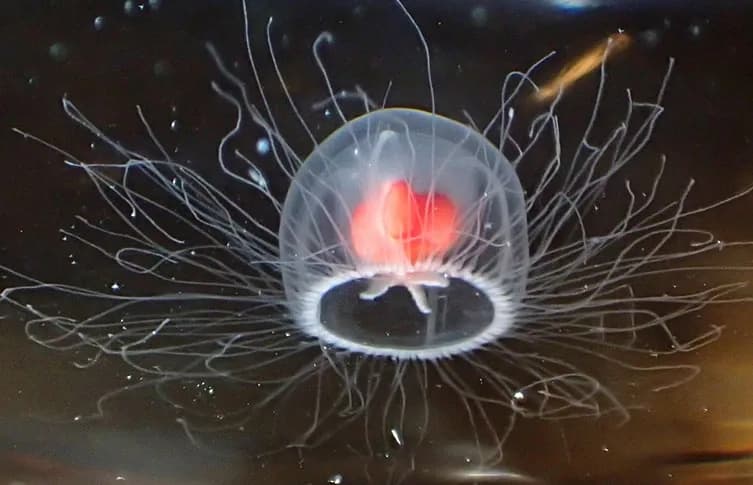
The immortal jellyfish can return from its adult form to an earlier stage of life and develop again. Scientists have observed this remarkable reversal, but it does not mean the animal is indestructible or that researchers have discovered how to make people live forever.
Its potential medical value is more specific. Understanding how this creature reorganizes its cells could help researchers investigate tissue repair and biological processes involved in aging. The evidence supports an extraordinary animal adaptation, while applications for human disease remain an open research question. pmc.ncbi.nlm.nih.gov
For readers wondering whether this is genuine science or another exaggerated longevity headline, that distinction matters.
A Tiny Animal With an Unusual Life Cycle
The species behind the nickname is Turritopsis dohrnii. Its adult body measures roughly 4.5 millimeters across, making it smaller than many people's little fingernails.
The familiar floating jellyfish is a developmental stage called a medusa. Earlier in its life, the animal exists as a polyp, a small structure attached to a surface. Polyps can produce new jellyfish that swim freely and grow into adults.
The immortal jellyfish can reverse that developmental direction. Under stressful conditions, including injury or starvation, an adult can reorganize itself and return to the polyp stage.
The Natural History Museum explains that this ability does not protect it from everything. Predators can eat the jellyfish, and its attached polyps are vulnerable too. Repeated rejuvenation is therefore different from guaranteed survival.
How the Immortal Jellyfish Restarts Its Life
Life cycle reversal involves rebuilding the animal's body, rather than simply making an adult jellyfish smaller.
First, the swimming body contracts and loses its familiar shape. It then enters an intermediate, cystlike stage. A polyp develops, and the resulting colony can eventually produce new medusae.
The American Museum of Natural History describes how this reversal fits into the animal's ordinary development. The polyp and medusa stages have different structures and functions, so moving between them requires substantial biological reorganization.
Researchers studying the immortal jellyfish investigate a process called transdifferentiation: a specialized cell changing into another specialized cell type.
A 2021 study of gene activity found increased activity in genes associated with DNA repair and other processes during the intermediate cyst stage. It also identified differences between polyps formed through reversal and those produced through ordinary development.
That finding adds an important nuance: structures that look similar can differ in their underlying molecular activity.
What Scientists Have Found in Its Genes
In a 2022 study published in PNAS, researchers compared the genomes of Turritopsis dohrnii and the related species Turritopsis rubra. They also examined gene activity during reversal.
The immortal jellyfish showed differences involving DNA copying and repair, responses to oxidative stress, maintenance of chromosome ends, and regulation of cellular identity.
Oxidative stress refers to damage associated with reactive chemicals in cells. Chromosome ends, called telomeres, help protect genetic material.
These findings suggest that several interacting systems may contribute to rejuvenation. They do not establish a single gene that could be transferred into humans to stop aging.
There is also a relevant scientific disagreement. In a 2023 critique, marine biologist Maria Pia Miglietta questioned the evidence used to characterize Turritopsis rubra as unable to rejuvenate after reproduction. The study's authors responded that their central description concerned the absence of reported evidence.
The distinction affects how confidently scientists can connect genetic differences to rejuvenation. It does not erase observations of developmental reversal.
Could the Immortal Jellyfish Help Researchers Treat Aging?
The plausible connection is through regenerative medicine, which investigates ways to repair or replace damaged cells and tissues.
A February 2026 Texas A&M University account of Miglietta's research describes the animal as a model for investigating cellular reprogramming. Understanding how cells change function could provide useful ideas for future experiments.
However, the immortal jellyfish studies discussed here do not demonstrate a treatment for Alzheimer's disease, Parkinson's disease, or human aging.
Separate research in mammals illustrates why cellular reprogramming attracts attention. In a 2020 Nature study, scientists altered the activity of three reprogramming factors in mouse retinal cells.
They reported improved visual function in aging mice and a mouse model of glaucoma, alongside regeneration after optic nerve injury.
That experiment did not use a jellyfish treatment. It addressed a related question: can changing a cell's regulatory state restore useful function?
The connection is conceptual. One research area examines a natural example of extensive cellular reorganization; the other tests controlled interventions in mammalian tissues.
Why Human Rejuvenation Is a Harder Problem
Lessons from the immortal jellyfish would need extensive testing before they could support a human therapy. A useful intervention must improve tissue function while preserving the jobs that cells already perform.
Consider a hypothetical treatment for an aging eye. Making retinal cells display younger molecular markers would be encouraging, but patients would need measurable benefits, such as improved vision.
Scientists would also need to establish whether those benefits lasted and whether the intervention caused harm.
Cellular reprogramming presents a particular concern: altering cell identity or growth control can encourage abnormal growth. The National Institute on Aging identifies tumor development as a risk researchers must address.
A successful approach would therefore require control over which cells change, how much they change, and when the intervention stops.
A Practical Way to Read Longevity Headlines
When a headline links the immortal jellyfish to longer human lives, ask three questions before accepting the conclusion.
First, what was studied? An observation in jellyfish, an experiment in mice, and a clinical trial involving people provide different kinds of evidence.
Second, what improved? Changes in gene activity or molecular markers are different from better vision, stronger muscles, or fewer disease symptoms.
Third, what remains unknown? Look for information about safety, the duration of any benefit, and whether independent researchers have reproduced the result.
For example, identifying an unusual DNA repair gene creates a research lead. Showing that changing its activity improves tissue repair would provide stronger mechanistic evidence. Demonstrating a safe benefit in patients would require additional research.
This framework helps readers recognize progress without treating every interesting finding as an available treatment.
Publication dates deserve attention, too. An article shared today may describe a study published several years earlier. Check the date of the original paper, then ask whether the new coverage adds an experiment, a correction, or simply renewed interest. This prevents an established observation from being mistaken for a fresh medical breakthrough and keeps expectations tied to what researchers actually tested.
What the Next Meaningful Discovery Would Show
The immortal jellyfish offers researchers a natural setting in which to investigate cellular rebuilding. Its scientific value does not depend on promises of eternal life.
The next useful advance would connect a specific biological mechanism to a measurable effect. Researchers would then need to investigate whether that mechanism has relevance beyond the animal itself.
For readers concerned about present symptoms, DailyUSWire's guide to memory loss after 60 addresses a more immediate issue: which changes to notice and discuss with a healthcare professional.
The immortal jellyfish remains fascinating because it expands the questions scientists can ask about development and repair. Turning those questions into medicine requires evidence that an intervention improves function, lasts long enough to matter, and can be used safely.